Water Quality Tester
Linshang offers a range of water quality testers. LS310 is a portable instrument designed for testing drinking water such as tap water, purified water and groundwater. It measures COD (Chemical Oxygen Demand), TOC (Total Organic Carbon), UV275 (Ultraviolet Absorption Value), TDS (Total Dissolved Solids), EC (Electrical Conductivity) and T (Temperature). Its intelligent scoring function quickly evaluates water quality, with the LCD backlight indicating four levels: excellent, good, average and poor. Based on LS310, LS311 adds SAL (Salinity), GH (General Hardness) and S.G. (Specific Gravity), making it suitable not only for drinking water testing, but also for seawater and aquaculture salinity measurement. When salinity exceeds 0.3%, Saline Water is indicated, and when salinity exceeds 5%, Hypersaline Water is indicated.
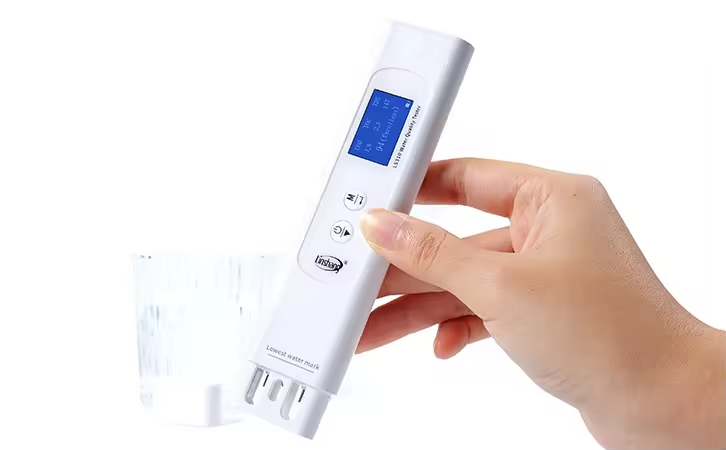
LS310 Water Quality Tester
No reagent, measure 6 water quality indicators
Intelligent scoring to determine the different levels of water
Pen type design and easy to carry
With ambient temperature compensation, stable value

LS311 Water Quality Tester
For drinking water and seawater aquaculture
Measures 9 params: COD, TOC, TDS, salinity and more
Smart scoring for water quality as Excellent, Good, Average or Poor
Color display with intuitive color-coded results
Ⅰ. Why Do You Need A Water Quality Tester?
Clean, safe water is essential for a healthy lifestyle, and with increasing concerns over water contaminants, investing in a reliable water quality tester is more important than ever. Whether you’re using a water quality test kit or a portable water tester pen, these water testing equipment empower you to ensure that every drop of water you consume meets the safety standards.
-
Safeguard Your Health
A water quality tester can quickly identify harmful substances such as bacteria, chlorine residues, heavy metals, and other pollutants before they affect your health. Lead exposure causes 1 million deaths yearly (WHO). Regular testing with a water quality detector minimizes the risk of waterborne diseases and long-term health issues caused by contaminated water.
-
Compliance and Peace of Mind
Stay informed about your water quality and comply with health and safety regulations. Routine checks with a water tester pen ensure that your water supply is consistently safe for consumption. Compact water tester pens allow you to test water on-the-go—whether at home, in the office, or during outdoor activities—ensuring safe water is always within reach.
-
Invest in Your Future
By catching water quality issues early, you can avoid expensive health treatments and costly infrastructure repairs down the line.
Don’t compromise on your family’s health. With a reliable water quality tester at your side, you’re taking a proactive step towards ensuring that the water you consume is pure, safe, and healthy every day.
Ⅱ. How to Choose the Best Water Quality Tester for Your Needs
When selecting a water quality tester, it’s crucial to evaluate your specific needs, usage environment, and budget. The market offers a wide range of devices—from advanced digital water quality testers such as the Linshang LS310 and LS311, to simple TDS pens and comprehensive water quality testing kits. In this guide, we compare key testing parameters, price, and portability to help you make an informed decision.
| Feature | LS311 Water Quality Tester | LS310 Water Quality Tester |
TDS Pen | Water Quality Testing Kit |
| Testing Parameters |
SAL, GH, S.G., COD, TOC, TDS, UV275, EC, Temperature |
COD, TOC, TDS, UV275, EC, Temperature |
Primarily measures TDS only | pH, TDS, chlorine, hardness, etc. |
| Requires Reagents? | No | Yes | ||
| Accuracy | High accuracy with advanced digital sensors |
Moderate accuracy | Varies by brand | |
| Price | Cost-effective (about $40) |
Cost-effective (about $36) |
Budget-friendly (about $10) |
Moderate (about $20 - $100) |
| Portability | Compact and highly portable | Bulkier | ||
| Usage | User-friendly interface with clear digital display |
Simple and straightforward | Requires more manual handling and interpretation | |
| Application | Home drinking water, tap water, purified water, groundwater seawater, aquaculture and etc. | Home drinking water, tap water, purified water, groundwater and etc. | Quick, on-the-go testing | Detailed water quality analysis |
Ⅲ. How To Test Drinking Water Quality?
Whether at home or outdorrs, testing drinking water quality with the LS310/LS311 Water Quality Tester is quick and easy. Just follow these simple steps:
-
Power On the Device
Press the power button to turn on the Water Quality Tester.
-
Immerse the Probe
Submerge the probe into the water, ensuring it reaches at least theminimum water level marked on the device.
-
Start the Test
Press the measure (M) button, the test results will be displayed on thescreen immediately, along with a color-backlight for easy interpretation.
With just a few simple steps, you can quickly assess whether your drinking water is safe!
Ⅳ. How Do I Compare My Test Results to Drinking Water Standards?
Understanding your water quality test results is easy with the LS310/LS311 Water Quality Tester. The device provides both numerical readings and an intuitive color-coded backlight, allowing users to quickly assess water safety based on drinking water standards.
-
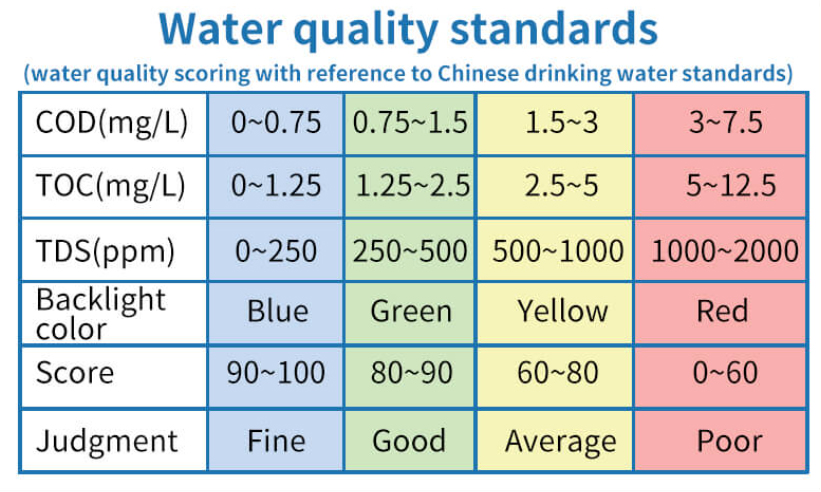
Check the Water Quality Scoring Chart
On the back of the LS310/LS311 Water Quality Tester, you will find a detailed water quality scoring chart. This chart helps interpret test results by comparing them to recommended water quality standards.
-
Use the Color-Coded Backlight for Instant Understanding
Even if you are unfamiliar with numerical test results, the four-color backlight indicator makes it easy to understand water quality at a glance:
Blue (Excellent): The water is very safe to drink, meeting high-quality standards.
Green (Good): The water is generally safe but may contain minor impurities.
Yellow (Moderate): The water quality is average, and filtration is recommended.
Red (Poor): The water is not safe for drinking and requires immediate treatment.
This intuitive system ensures that even elderly individuals and children can easily determine whether the water is safe to drink. No need for complex calculations—just check the screen color and take necessary action if needed.
Ⅴ. LS310/LS311 Water Quality Tester V.S TDS Pen
A TDS pen measures Total Dissolved Solids (TDS), but TDS alone cannot determine overall water quality. High TDS does not always mean unsafe water, and low TDS does not guarantee purity. It only indicates the concentration of dissolved ions, missing critical factors like temperature and contaminants.
In contrast, the LS310 Water Quality Tester analyzes six key water quality parameters, including TDS, temperature, COD, TOC, UV275 and EC. Building on the LS310, the LS311 Water Quality Tester adds SAL, GH and S.G., providing a more comprehensive water quality evaluation. With the intelligent scoring system and color-coded backlight, the LS310 and LS311 Water Quality Tester offer a far more accurate and reliable assessment of whether water is truly good.
Ⅵ. How To Calibrate Water Quality Pen?
The LS310/LS311 Water Quality Tester allows users to easily calibrate the device for accurate measurements using pure or distilled water. Follow these simple steps:
Power On: Press the power button to turn on the device.
Enter Calibration Interface: Long press the measurement button until the calibration screen appears.
Follow Screen Prompts: The device will guide you through the calibration process step by step.
For a detailed demonstration, please refer to the calibration video below.
Ⅶ. FAQs
1. Does the LS310/LS311 require test reagents?
No, the LS310 and LS311 use advanced sensor technology, eliminating the need for chemical reagents, making it faster and more convenient than traditional water testing kits.
2. Can the LS310/LS311 detect heavy metals or bacteria?
The LS310 and LS311 water quality testers can test drinking water for COD, TOC, TDS, and EC, but they cannot detect specific heavy metals, bacteria, or chemicals. For such tests, please consider specialized laboratory tests or reagent-based kits.
3. What’s the best water tester for home use?
For most households, the LS310 Water Quality Tester is the top choice—it’s affordable, easy to use ( no reagents required), and covers essential parameters.
4. What if I need to measure salinity in aquarium or fish tank water?
If you need to measure salinity in aquarium, fish tank, or aquaculture water, the LS311 Water Quality Tester is recommended. Based on the LS310, it adds Salinity (SAL), General Hardness (GH) and Specific Gravity (S.G.), making it suitable for both drinking water and saline water applications.